
The influence of Polish immigrants in Chicago began in the late 1800s, driven primarily by economic and structural change in Poland at the time. Not surprisingly, Polish culture and art took root in the diverse backdrop of Chicago history. The following entry takes a deeper look at some of Poland’s most acclaimed artists and their importance in Polish culture and the greater art world.
MIR Appraisal Services, Inc. has had the great fortune of researching artwork by Polish artists such as Piotr Stachiewicz, Teodor Axentowicz, Aleksander Augustynowicz, and Wladyslaw Teodor Benda.

Born in 1858, Piotr Stachiewicz was primarily a portrait painter. Stachiewicz was also an illustrator, creating images for novels and Krakow’s bi-weekly publication of “The World”. His painting (above) entitled “Portrait of Sarah Bernhard” from 1890 shows his affinity and talent for portraiture. His portraits of women, particularly in the native dress of his home country, were not only descriptive of Polish culture, but also illustrious images, indicative of the wealth of art produced by Polish contemporaries. Portraiture of beautiful women became a theme of many Polish artists during the time, including Teodor Axentowicz.


Teodor Axentowicz began as an illustrator for ‘Le monde illustre’ doing popular copies of works by masters Botticelli, Titian, Valezquez, and Correggio. His portraiture career took off in London, England. In 1890 alone, he was commissioned to paint twelve portraits. His subjects included actress Sarah Bernhardt, Henrietta Fouquier, and Wladyslaw Oslawski. The Oslawski portrait earned him a position in the Societe Nationale des Beaux Arts in 1890. His canvases were truly unique and advanced the art of portraiture during his time. The use of pastels created a lovely and delicate representation of the many women he depicted. Axentowicx drew inspiration from artists like J. Whistler, John Singer Sargent, and G.J. Boldiniego and painted with a narrow range of colors, employing subtle feminine qualities, highlighting delicateness and a sentimental character. His artwork was exhibited domestically and internationally, reaching Chicago in 1927.

Polish artist Aleksander Augustynowicz also became well known for his portraits. Augustynowicz studied at the Krakow School of Fine Arts under Feliks Szynalewski, Wladyslaw Luszczkiewicz, and Jan Matejko. His works were exhibited in Krakow, Lwow, Poznan, and Warsaw, as well as in Berlin, Vienna, London, and Munich. The artist explored other genres apart from portraiture, such as landscape and scenes of everyday life, however, he will forever be remembered as a portrait painter.
Another Polish artist who did trained at the Krakow School of Fine Arts was Wladyslaw Teodor Benda.

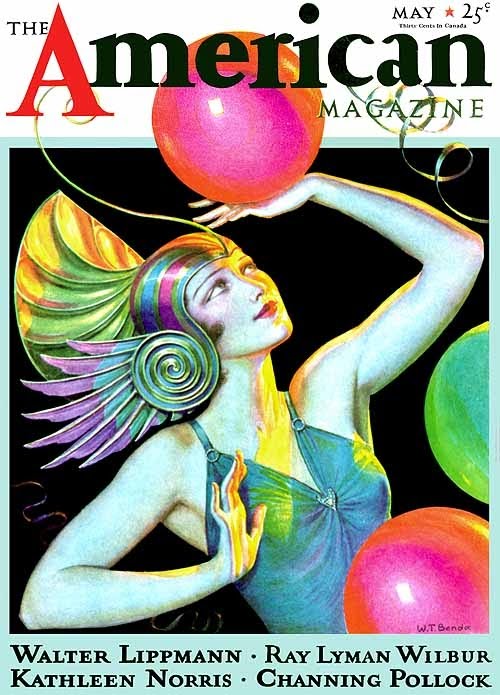
Benda was born January 15, 1873 in Poznań, Poland. The son of a musician, Benda’s childhood was filled with creative and talented people, including his aunt, actress Helena Modrzejewska (known as Helena Modjeska in the United States). After studying at the Krakow School of Fine Arts, he traveled to the United States. With the help of his aunt, he began his career as a set and costume designer. The actress got Benda a job designing her production of Shakespeare’s Antony and Cleopatra in Los Angeles. Later, the artist moved to New York City and started concentrating on painting, where his portraits of women gained him recognition. Benda also became an illustrator for advertising agencies and magazines, designing covers for Collier’s McCalls, Ladies’ Home Journal, and Good Housekeeping, which incorporated the beautiful portraits of women that had made him so famous.

(Left: Redcross Magazine, "The Drive for Home" (1919) Bend)
(Right: Cosmopolitan (1927) Benda)
Benda’s women were exotic and fierce, They were “darker, more mysterious, more foreign, not apple-pie pretty like Fishers’ Phillips’, or Christy’s girls”.[i]

(Left: The Shrine (1927) Benda)
(Right: Cosmopolitan, "The Hour" (1917) Benda)
Benda’s work has appeared in museums and collections throughout the world and Chicago is no exception. In the Polish Museum of Chicago there are nearly 100 posters and over 10 of Benda’s drawings. They portray a variety of themes, beginning with nature, portraits of women, and ending with historical subjects. Posters relating to World War I are also on display as well as two masks of the face of his aunt, Helena Modrzejewska.[ii]
MIR Appraisal Services, Inc. has had the good fortune of appraising pieces by Piotr Stachiewicz, Aleksander Augustynowicz, Teodor Axentowicz, and Wladyslaw Teodor Benda. As a research-oriented appraisal office, MIR is staffed with appraisers and researchers with a wide array of specialties and are as competent appraising an Abstract Expressionist oil painting as they are a portrait miniature or a diamond ring. We welcome you to explore our website and encourage you to call us with any questions you may have about our services. We are located on Chicago's Michigan Avenue, and we encourage you to schedule an appointment to visit our office and appraisal staff.
Written and researched by Taylor Maatman
MIR Appraisal Services, Inc.
Principal Appraiser: Farhad Radfar, ISA AM
307 N. Michigan Avenue, Suite 308
Chicago, IL 60601
Phone: (312) 814-8510
[i] http://www.americanartarchives.com/benda.htm
[ii] http://www.polishmuseumofamerica.org/v4/EnglishVersion/PMAMuseum.htm
http://www.thekf.org/kf/


 Posts
Posts


