My blog has moved!

You should be automatically redirected in 4 seconds. If not, visit
http://mirappraisal.com/mir-blog/
and update your bookmarks.

Showing posts with label art appraisals. Show all posts

Tuesday, August 10, 2010

The Chicago Cultural Center: A Chicago Landmark & Gem in the Heart of Downtown


Chicagoans can visit the Chicago Cultural Center on the corner of Washington Street and Michigan Avenue for countless visual, literary, and performing arts programs. Built in 1897, and originally the home of Chicago’s public library, the building is now a venue for cultural and artistic expression. This hidden treasure of Chicago’s architectural, artistic, and cultural history holds more than 700 events, free to the public, every year.


The exterior may cause visitors to overlook the building; however, the divine marble, stone, hardwood, stained glass and mosaics in the interior will surely change your mind. Its masterpiece is the world’s largest stained glass Tiffany dome. Over 40 feet in diameter, the dome was restored in 2008 and resides in Preston Bradley Hall, which houses free music events throughout the year.
Other events include artist exhibitions, lectures, films, and concerts.


Pictured above is the stained glass Tiffany dome designed in an intricate Renaissance pattern. Restored in 2008, the dome is an artistic marvel and can be visited for free at the Cultural Center.


Below is the grand staircase with a view of the Tiffany dome. The staircase is lined with pink and white marble and features countless mosaics inscribed with names of the greatest writers and philosophers of our time.


The Chicago Cultural Center is home to many traveling art exhibits, free and open to the public Monday through Thursday 10-7, Friday 10-6, and Saturday and Sunday until 5pm.


Upcoming events at the Cultural Center include Gallery Talks from artist Jackie Kazarian and art historian Michael Bonesteel, as well as the photography exhibit "Polaridad Complimentaria: Recent Works from Cuba" starting October 15th, a traveling exhibition showcasing new artistic talent from Cuba.


The building dubbed “The People’s Palace” celebrates art, culture, and education. There are a number of family programs and events held at the Cultural Center, including private parties and weddings. The lavish marble and stained glass backdrop is stunningly romantic, combining a historic and contemporary Chicago feel.


Only steps from the Art Institute of Chicago and Millennium Park, the Chicago Cultural Center is a must-see for any tour of Chicago. Whether it’s your first time to Chicago, or you have lived here for years, the cultural center is truly a landmark of the city. Even a simple stroll through the building leaves one with a sense of grandeur and timelessness.


For a quick visit, enter on Randolph Street through classical Doric columned doors. You’ll be engulfed by the high coffered ceiling and green and pink marble walls. Make your way up the curving staircase and look to see if you recognize any of the names in the detailed mosaic walls.

The Washington Street entrance greets visitors with a grand staircase, and a three-story vaulted lobby. White walls of Carrara marble surround you containing Favrile glass, stone, and mother of pearl details throughout. The coup de grâce is, of course, the Tiffany stained-glass dome at the top of the stairs. A must-see for art lovers, Chicagoans, and visitors to the city.


Researched and written by Taylor Maatman

MIR Appraisal Services, Inc.

Principal Appraiser: Farhad Radfar, ISA AM

307 N. Michigan Avenue, Suite 308

Chicago, IL 60601

(312) 814-8510


MIR Appraisal Services, Inc., is mere blocks from the Chicago Cultural Center—please include MIR in your Chicago “art tour.” Consider viewing several works by Chicago artists in our collection, including those of the late Ruth Duckworth and Emmanuel Viviano. We would also be delighted to evaluate your most prized works of art; a verbal evaluation is a fun, convenient and cost-effective way to gain valuable knowledge regarding your precious belongings. Please contact our friendly staff to set up an appointment!


Works Cited:

http://www.cityofchicago.org/city/en/depts/dca/provdrs/chicago_culturalcenter.html

http://en.wikipedia.org/wiki/Chicago_Cultural_Center

http://www.explorechicago.org/city/en/supporting_narrative/attractions/dca_tourism/Chicago_Cultural_Center.html


Wednesday, August 4, 2010

Works, Letters & Photographs from Peter Blume Collection Arrive at MIR

“In my work there’s always a kind of destruction plus thrust,
something dynamic.”

—Peter Blume
(Chicago Tribune 1976)

The work of Peter Blume is striking. His work startles the eye with its merger of great spans of color and minute detail. The viewer is instantly drawn to bold, seamless shapes rendered with vibrant precision. With this nearly menacing, technical precision, he builds the stuff of allegory, considering grandly themes of decay and renewal in “imaginary gardens with real toads in them,” as Marianne Moore put it.

One sees the work and questions arise such as “Who is this man? Where did he learn his craft?” Blume’s foremost building materials include motifs of stones and girders; the human animal, with her curiosity about the artist and his thematic obsessions, longs to stand among these mysterious stones and scrutinize his scenes from every angle.

The Rock

Born in Smorgon in Russia in 1906, Blume immigrated with his family to New York in 1912; at fifteen, he began schooling at the Educational Alliance, later studying at the Art Students League (http://www.nytimes.com/). Writer Malcolm Cowley, Blume’s friend and, later in life, his next-door-neighbor, recalls meeting Blume in 1928 in New York. Blume lived on 75 dollars per month—the allowance given to him by Charles Daniel’s gallery (one of the first galleries to showcase modern art)—and he roomed in and out of friends’ studios. Cowley gave him a lead on Addie Turner’s four room unheated house in the country, where he would live for nearly a year; the poet Hart Crane lived at times across the hall from Blume, where he was composing his epic poem The Bridge (Trapp 8).

The recipient of a Guggenheim Fellowship in 1932, Blume traveled to Italy and found inspiration for his masterwork Eternal City, which showcases the bloated head of Mussolini in a fantastical landscape.

Eternal City

Julien Levy featured the painting in a one-man, one-work show.

Blume’s work was also included in the Museum of Modern Art’s 1943 exhibition “American Realists and Magic Realists”; in the exhibition catalogue, Lincoln Kirstein characterizes the works as owning “crisp hard edges, tightly indicated forms, and the counterfeiting of material surfaces” (http://www.oxfordreference.com).

Unearthing the life and works of an artist, and understanding personal history and artistic concerns within a cultural context-- these activities frame some of our principle aims at MIR Appraisal Services. In our work as art appraisers, the analysis of an artist’s oeuvre in terms of personal biography can add support to the authenticity and value of the art in question; physical evidence, such as photographs and letters, can add to the value of the work. Recently we were given the privilege of examining some of Mr. Blume’s original work as well as artifacts from his personal life, brought into us by the great-nieces of his wife, Grace Douglas (Ebie) Blume. What an honor to hold in our hands family letters and photographs, as well as more personal, less well-known works of the artist—to examine the roots of family history and the roots of the artist’s work.

Figures, from left to right: Ebie, Marshall, Peter and Ann;
Ann's garden in Alexandria, VA
[See Blume's artistic rendering of the garden in Housewarming, an image that follows shortly]


Letter from Ebie Blume to her great-niece, in which she discusses the writer James Thurber, her friend and neighbor

Roberta Smith of the New York Times notes that Blume’s work “combined such disparate influences as folk art and Precisionism with aspects of Parisian Purism and Cubism and later Surrealism” (http://www.nytimes.com/). Even keeping this stylistic range in mind, it is surprising and charming to witness quiet domestic scenes from the family’s collection:

Housewarming, marked on the verso “View from Ann’s window”

To comprehend the ways in which personal history and artistic vision interpenetrate, consider his pivotal work South of Scranton, now in the permanent collection at the Metropolitan Museum of Art-- a painting inspired by the sight of German sailors exercising on their vessel “Emden” in the Charleston harbor.

South of Scranton

In Blume’s translation, the navy sailors became, in his words, “birds soaring through space” (http://www.metmuseum.org/).

In a 1976 interview in the Chicago Tribune, Blume expressed interest in seeing, in general, “the range of experience in art expanded; a Caravaggian quality of light reintegrated; illusion of space, texture and reality, restored. All of which points to a fresh interest in human concerns” (Chicago Tribune 1976). In terms of his own work, he listed his lofty aims with humility: “As an affirmation of the virtues and qualities of life, I would like to tie all these things together in my work before I die. Not as the last word, but just to absolve myself of any negation. Not only on the part of so-called philosophical expression, but also on the purely technical side. There are so many things that we have forgotten. And maybe I’ve neglected them, too” (Chicago Tribune 1976).

* * *

Researched and written by Anja Keppeler and Jessica Savitz

MIR Appraisal Services, Inc.
Principal Appraiser: Farhad Radfar, ISA AM
307 N. Michigan Avenue, Suite 308
Chicago, IL 60601
(312) 814-8510

MIR Appraisal Services is located just steps from the Art Institute of Chicago and the Chicago Cultural Center; please do give us a ring to set up an appointment for a verbal evaluation of your most prized works of art.

Works Cited

http://www.metmuseum.org/
http://www.moma.org/
http://www.nytimes.com/
http://www.oxfordreference.com/views/ENTRY.html?subview=Main&entry=t238.e852
Chicago Tribune. 18 Jan. 1976.
Trapp, Frank Anderson. Peter Blume. New York: Rizzoli, 1987.

Tuesday, April 13, 2010

The Avant-Garde and Modernism at the Art Institute of Chicago

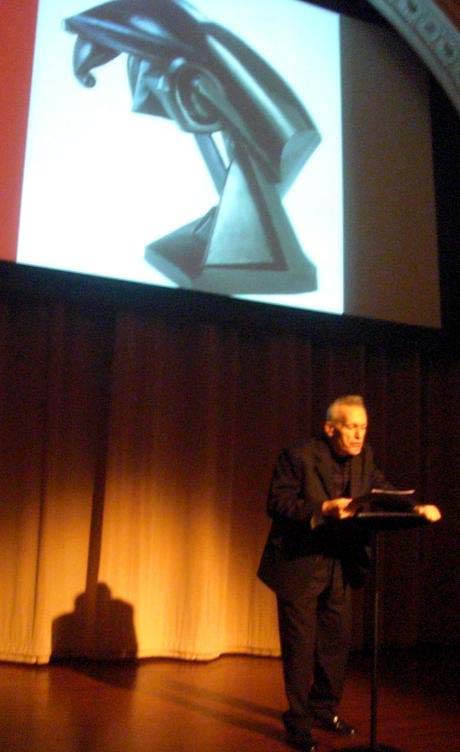
A few weeks past, I attended an event in Fullerton Hall at the Art Institute of Chicago—mainstage actors Barbara Robertson and Larry Yando from the Goodman Theatre, in conjunction with the Poetry Foundation, performed excerpts of prose, plays and poetry by modernist, avant-garde writers, as part of the “500 Ways of Looking at Modern” series. The lead speaker articulately bridged the works within the overarching avant-garde movement. Projected images of great works of art in the very pretty Fullerton Hall created a magical atmosphere (perhaps answering the residual memories of excitedly witnessing projected images in the darkened assembly of art history classes).


Paul Cezanne, The Bathers


As we dragged to light in the 20th century “the recreation of the perception of our world,” we witness self-referential works—we investigate “thinking about thinking.”


Picasso, Les Demoiselles d’Avignon


Cubism is “simultaneous awareness”—the “shatter” of a surface, allowing us to view the subject from an infinite number of angles.


Guillaume Apollinaire


Apollinaire, the “tireless supporter of the cubist arts,” heralded the new in his poem “Zone”—it is perhaps a love poem to the 20th century, a casting off of the deathish past—“In the end you are weary of this ancient world.” Apollinaire attended Picasso’s Parade and subsequently coined the term “surreal.”


Picasso, Apollinaire


Apollinaire read the works of Pascal to Picasso as he painted. Apollinaire made arrangements that after his death, Pascal’s Pensees be delivered to Picasso.


Verdone proclaimed, “The artist must be in the avant-garde” as in the military; Robertson and Yando sang a marvelous duet about the army—visualizing a new world through the metaphor of war. As in Mina Loy’s “shattered glass/ into evacuate craters” from “Lunar Baedeker,” read by Barbara Robertson,


to shatter a surface into different angles requires a certain violence, like tapping at a mirror with a little hammer, and admiring the disjointed, infinite views emanating from the broken surface.


Mina Loy


To quote Stein, this is a “violent kind of delightfulness.”


Picasso, Gertrude Stein


The avant-garde artists orbited about the scene built by Gertrude Stein and Alice B. Toklas. Barbara Robertson gave a generous and lush reading of “A Substance in a Cushion” from Stein’s Tender Buttons: “What is the use of a violent kind of delightfulness if there is no pleasure in not getting tired of it. The question does not come before there is a quotation. In any kind of place there is a top to covering and it is a pleasure at any rate there is some venturing in refusing to believe nonsense. It shows what use there is in a whole piece if one uses it and it is extreme and very likely the little things could be dearer but in any case there is a bargain and if there is the best thing to do is to take it away and wear it and then be reckless be reckless and resolved on returning gratitude” (Stein 10).


Stein, at once ironic and earnest, wittily defended the intelligibility and accessibility of her work, proclaiming, “If you enjoy it, you understand it and lots of people have enjoyed it so lots of people have understood it… all you must enjoy my writing and if you enjoy it you understand it. If you did not enjoy it, why do you make a fuss about it? There is the real answer”. (Check out the superb sound recording here: http://media.sas.upenn.edu/pennsound/authors/Stein/Stein-Gertrude_Interview_1934.mp3).


Various mediums interpenetrated to arrive at new art forms in music, painting, poetry, theater (as in Stein’s libretto for Four Saints in Three Acts, an opera).


Robertson reciting Stein


Orphism, Imagism, Futurism, the Dada, Surrealism—all sprouted from the body of the avant-garde.


Larry Yando roared out Marinetti’s futurist manifesto: “Let’s break out of the horrible shell of wisdom and throw ourselves like pride-ripened fruit into the wide, contorted mouth of the wind!”


Filippo Marinetti


Robertson indeed sang the “love of danger” in “we want to exult aggressive motion”:


Tzara turned inward to confront the artist’s psyche; following his instructions to cut up a newspaper, place the pieces in a bag, and then select the clippings to construct a poem, Tzara declared that “the poem will resemble you.”


Tristan Tzara


Kandsinsky asked, “Why couldn’t painting be more like music?” (and then made it so).


Wassily Kandinsky, Improvisation 31 (Sea Battle)


Theo Van Doesburg aimed to “turn up the volume on color and constancy”; his poetry runs parallel to Mondrian’s aesthetic.


Theo Van Doesburg


Piet Mondrian


Kurt Schwitters declared, “The basic material of poetry is not the word but the letter”; the actors performed his “W.”


Kurt Schwitters


Yando performed Eluard’s “Nearer To Us” (“run and run towards deliverance/ And find and gather everything/Deliverance and riches/ Run so quickly the thread breaks…” and sang Brecht’s lyrics for the ballad “Mack the Knife” from TheThreepenny Opera—the final line is so satisfyingly abrupt, cut knife-like: “There in darkness/ drop from sight.”


The evening closed with a moving excerpt from Beckett’s Waiting for Godot, executed cleverly and with a great deal of sensitivity; an appropriate end with its modern sensibilities, its ambiguity and existentialism.


Samuel Beckett


* * *


The staff at MIR Appraisal Services, Inc. seeks to fully understand the arts in their particular cultural contexts and to analyze relationships between various artistic mediums and genres; in this way we can broaden our expertise as art appraisers. We are located just steps from the Art Institute of Chicago and the Chicago Cultural Center; please do give us a ring to set up an appointment for a verbal evaluation of your most prized works of art.


Written and Researched by Jessica Savitz


MIR Appraisal Services, Inc.

Principal Appraiser: Farhad Radfar, ISA AM

307 N. Michigan Avenue, Suite 308

Chicago, IL 60601

(312) 814-8510


Works Cited:

Stein, Gertrude. Tender Buttons. Los Angeles: Sun & Moon Press, 1991.

Twitter Updates

    follow me on Twitter

    MIR Art Appraisers's Fan Box

    MIR Art Appraisers on Facebook

    Profile:

    My photo
    Chicago, Illinois, United States
    Welcome to our blog site! MIR Appraisal Services, Inc. is a fine art and personal property appraisal company dedicated to serving clients throughout the United States and abroad since our incorporation in Chicago in 1994. We specialize in the multi-faceted field of appraising fine art, jewelry, antiques, and decorative items. We also provide professional fine art restoration and conservation treatment for various media, including but not limited to, artworks on canvas, board, masonite, and paper. We offer professional and precise appraisal services carried out by our team of accredited appraisers for the purposes of insurance coverage and claims, charitable donations, estate planning and probate, equitable distribution and fair-market value. We started our art commentary blog site as a venue for colleagues and fellow art enthusiasts to share their experiences within the art community.