My blog has moved!

You should be automatically redirected in 4 seconds. If not, visit
http://mirappraisal.com/mir-blog/
and update your bookmarks.

Showing posts with label Modernism. Show all posts

Tuesday, April 13, 2010

The Avant-Garde and Modernism at the Art Institute of Chicago

A few weeks past, I attended an event in Fullerton Hall at the Art Institute of Chicago—mainstage actors Barbara Robertson and Larry Yando from the Goodman Theatre, in conjunction with the Poetry Foundation, performed excerpts of prose, plays and poetry by modernist, avant-garde writers, as part of the “500 Ways of Looking at Modern” series. The lead speaker articulately bridged the works within the overarching avant-garde movement. Projected images of great works of art in the very pretty Fullerton Hall created a magical atmosphere (perhaps answering the residual memories of excitedly witnessing projected images in the darkened assembly of art history classes).


Paul Cezanne, The Bathers


As we dragged to light in the 20th century “the recreation of the perception of our world,” we witness self-referential works—we investigate “thinking about thinking.”


Picasso, Les Demoiselles d’Avignon


Cubism is “simultaneous awareness”—the “shatter” of a surface, allowing us to view the subject from an infinite number of angles.


Guillaume Apollinaire


Apollinaire, the “tireless supporter of the cubist arts,” heralded the new in his poem “Zone”—it is perhaps a love poem to the 20th century, a casting off of the deathish past—“In the end you are weary of this ancient world.” Apollinaire attended Picasso’s Parade and subsequently coined the term “surreal.”


Picasso, Apollinaire


Apollinaire read the works of Pascal to Picasso as he painted. Apollinaire made arrangements that after his death, Pascal’s Pensees be delivered to Picasso.


Verdone proclaimed, “The artist must be in the avant-garde” as in the military; Robertson and Yando sang a marvelous duet about the army—visualizing a new world through the metaphor of war. As in Mina Loy’s “shattered glass/ into evacuate craters” from “Lunar Baedeker,” read by Barbara Robertson,


to shatter a surface into different angles requires a certain violence, like tapping at a mirror with a little hammer, and admiring the disjointed, infinite views emanating from the broken surface.


Mina Loy


To quote Stein, this is a “violent kind of delightfulness.”


Picasso, Gertrude Stein


The avant-garde artists orbited about the scene built by Gertrude Stein and Alice B. Toklas. Barbara Robertson gave a generous and lush reading of “A Substance in a Cushion” from Stein’s Tender Buttons: “What is the use of a violent kind of delightfulness if there is no pleasure in not getting tired of it. The question does not come before there is a quotation. In any kind of place there is a top to covering and it is a pleasure at any rate there is some venturing in refusing to believe nonsense. It shows what use there is in a whole piece if one uses it and it is extreme and very likely the little things could be dearer but in any case there is a bargain and if there is the best thing to do is to take it away and wear it and then be reckless be reckless and resolved on returning gratitude” (Stein 10).


Stein, at once ironic and earnest, wittily defended the intelligibility and accessibility of her work, proclaiming, “If you enjoy it, you understand it and lots of people have enjoyed it so lots of people have understood it… all you must enjoy my writing and if you enjoy it you understand it. If you did not enjoy it, why do you make a fuss about it? There is the real answer”. (Check out the superb sound recording here: http://media.sas.upenn.edu/pennsound/authors/Stein/Stein-Gertrude_Interview_1934.mp3).


Various mediums interpenetrated to arrive at new art forms in music, painting, poetry, theater (as in Stein’s libretto for Four Saints in Three Acts, an opera).


Robertson reciting Stein


Orphism, Imagism, Futurism, the Dada, Surrealism—all sprouted from the body of the avant-garde.
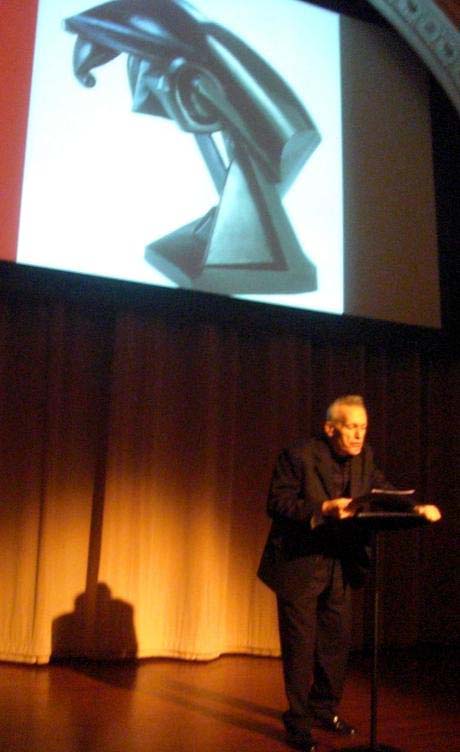

Larry Yando roared out Marinetti’s futurist manifesto: “Let’s break out of the horrible shell of wisdom and throw ourselves like pride-ripened fruit into the wide, contorted mouth of the wind!”


Filippo Marinetti


Robertson indeed sang the “love of danger” in “we want to exult aggressive motion”:


Tzara turned inward to confront the artist’s psyche; following his instructions to cut up a newspaper, place the pieces in a bag, and then select the clippings to construct a poem, Tzara declared that “the poem will resemble you.”


Tristan Tzara


Kandsinsky asked, “Why couldn’t painting be more like music?” (and then made it so).


Wassily Kandinsky, Improvisation 31 (Sea Battle)


Theo Van Doesburg aimed to “turn up the volume on color and constancy”; his poetry runs parallel to Mondrian’s aesthetic.


Theo Van Doesburg


Piet Mondrian


Kurt Schwitters declared, “The basic material of poetry is not the word but the letter”; the actors performed his “W.”


Kurt Schwitters


Yando performed Eluard’s “Nearer To Us” (“run and run towards deliverance/ And find and gather everything/Deliverance and riches/ Run so quickly the thread breaks…” and sang Brecht’s lyrics for the ballad “Mack the Knife” from TheThreepenny Opera—the final line is so satisfyingly abrupt, cut knife-like: “There in darkness/ drop from sight.”


The evening closed with a moving excerpt from Beckett’s Waiting for Godot, executed cleverly and with a great deal of sensitivity; an appropriate end with its modern sensibilities, its ambiguity and existentialism.


Samuel Beckett


* * *


The staff at MIR Appraisal Services, Inc. seeks to fully understand the arts in their particular cultural contexts and to analyze relationships between various artistic mediums and genres; in this way we can broaden our expertise as art appraisers. We are located just steps from the Art Institute of Chicago and the Chicago Cultural Center; please do give us a ring to set up an appointment for a verbal evaluation of your most prized works of art.


Written and Researched by Jessica Savitz


MIR Appraisal Services, Inc.

Principal Appraiser: Farhad Radfar, ISA AM

307 N. Michigan Avenue, Suite 308

Chicago, IL 60601

(312) 814-8510


Works Cited:

Stein, Gertrude. Tender Buttons. Los Angeles: Sun & Moon Press, 1991.

Tuesday, February 3, 2009

Erte: Fashion, Modernism, and Fine Art


Personal property appraisers often work with several categories of objects, from sports memorabilia to fine art objects. However, sometimes appraisers come across objects that transcend a single category. These types of objects are often highly interesting and can be highly valuable because they are collectible for so many reasons. A great example is the work of Romain de Tirtoff, better known by his pseudonym Erte.

Erte, known as a graphic artist and dress designer, was born in St. Petersburg, Russia in 1892, but moved to Paris, France between 1910 and 1912 to explore a career in fashion. He had his artistic breakthrough as a dress designer for the couture house of Paul Poiret. Being a dress designer Erte made fashion sketches for his work. Eventually these creations would take on a life of their own, so that Erte was making prints that portrayed whole scenes in which a fully realized figure would be shown wearing Erte designs within a stylized setting. Erte was able to use his talent as a graphic artist to create works that not only led to fashion designs but were also art objects in there own right.

Erte’s work is, therefore, highly collectible for numerous reasons. They are collectible as fashion items because they show the development of Erte’s designs. For example, some of his early drawings eventually led to clothes that would have been produced by one of the great fashion houses of the early 20th century. His drawings, paintings, and prints are also historical documents because they are linked to the modernist age, and are a prime example of how society was changing, even in terms of dress. This is due to Erte’s connection to Paul Poiret, who is known for liberating women from the restraining corset; and instead designing items that were loose fitting, allowing for greater female mobility. Upon examining Erte’s drawing, shown to the left, you can see this approach to dress. We see a woman, in loose fitting pants, moving in a fluid manner. It demonstrates a style of dress, which allows an active movement. Finally, these drawings are interesting fine art objects. Regardless of the fashion or cultural connection they can stand alone as visually appealing. Each exhibits fluid movement with lines that curve in combination with long strait lines; used in conjunction with vibrant colors and stylized, clearly outlined, shapes.

The work of Erte is very interesting to appraisers because it is collectible on so many levels. It has appeal to fashion enthusiasts, those interested in modernism, and collectors of fine art.
References:
Troy, Nancy J. Couture Culture: A Study in Modern Art and Fashion. Cambridge: The MIT Press, 2003.
Erte [Romain de Tirtoff]. My Life / My Art: An Autobiography. New York: E. P. Dutton, 1989.

Wednesday, December 31, 2008

Ruth Duckworth's Organic Creations & Philosophy

Everyday art appraisers examine a variety of objects from a variety of time periods and genres. From an appraiser's unbiased point of view, it is more important to understand a particular genre and not whether or not it fits your particular taste. Although I greatly enjoy modernist pieces, I understand that not everyone is of a similar mindset. Therefore, I would like to visually examine a notable piece of modernist sculpture, discuss the possible creative philosophies of the artist who made it, and explain why I appreciate it.

The above sculpture, currently at MIR Appraisal Services, Inc., was created by Ruth Duckworth. She was born in Hamburg Germany in 1919, but fled Nazi Germany for England at the age of 17. Duckworth began her formal art training at the Liverpool School of Art, then studied at the Hammersmith School of Art, and finally went to the Central School of Arts and Crafts in London. Eventually Duckworth would move to Chicago to teach at the University of Chicago, which she did until 1977. She is known to still live in the Chicago and continues to sculpt.

Beyond the facts of Duckworth’s life, what I find interesting about her work is that she produces pieces that are entirely unique to both the art world and to the broader genre of everyday objects. What I mean by this is that her work is removed from common visual forms and preconceived notions of what a ceramic, bronze, or clay object is suppose to look like. Instead Duckworth’s sculptures only attempt to be just what they are, nothing more. In her work, she does not attempt to depict people, animals or bowls; they simply are what they are, art objects. Furthermore, what makes Duckworth’s sculptures interesting is that they are unique extensions of the artist herself. Meaning that although Duckworth has gone through many creative phases processes, in which she has used varied materials, the underlying tie that binds her creativity, appears to be the organic creation of her pieces. In the artists own words “I don’t want to think. I want it to happen by itself, to flow up.” She is creating works that for the first time exist in the world through her intuitive feel for the materials she uses.

The Duckworth sculpture, currently at MIR Appraisal Services, Inc. is an example of the organic creative methods that the artist uses. This ceramic stone ware and mixed media work consists of two long and rounded pieces in the center that converge at one side, but remain open at the other end. Each extremity emerging from the central torso has been extended gracefully by the artist, so that there is a seamless flow throughout the work's entirety. This particular sculpture is a fine example and testament to Ruth Duckworth's creative philosophy with its unique appearance and organically sculpted limbs.

For more information or acquisition inquiries on this newly restored Ruth Duckworth sculpture, please contact MIR Appraisal Services, Inc. in Chicago at (312) 814-8510 or email us at mirappraisal@aol.com.

-MIR Appraisal Services, Inc.

Resources Consulted & Further Reading:

Hales, Linda.”Ruth Duckworth: Modernist Sculptor.”Washington Post (Sept. 4, 2006): C01, http://www.washingtonpost.com/gog/exhibits/ruth-duckworth-modernist-sculptor,1127401.html


Stair, Julian.“Duckworth’s volumes and planes: a traveling retrospective examines the 60-year career of sculptor Ruth Duckworth, whose reductive vessels and blocky figures reflect the coolness of international modernism.”Art in America (Dec., 2005), http://findarticles.com/p/articles/mi_m1248/is_11_93/ai_n15979877

Twitter Updates

    follow me on Twitter

    MIR Art Appraisers's Fan Box

    MIR Art Appraisers on Facebook

    Profile:

    My photo
    Chicago, Illinois, United States
    Welcome to our blog site! MIR Appraisal Services, Inc. is a fine art and personal property appraisal company dedicated to serving clients throughout the United States and abroad since our incorporation in Chicago in 1994. We specialize in the multi-faceted field of appraising fine art, jewelry, antiques, and decorative items. We also provide professional fine art restoration and conservation treatment for various media, including but not limited to, artworks on canvas, board, masonite, and paper. We offer professional and precise appraisal services carried out by our team of accredited appraisers for the purposes of insurance coverage and claims, charitable donations, estate planning and probate, equitable distribution and fair-market value. We started our art commentary blog site as a venue for colleagues and fellow art enthusiasts to share their experiences within the art community.