Facebook Badge
Monday, June 28, 2010
A Tribute to Chicago Painters, c. Late 19th-Early 20th Centuries
Friday, April 9, 2010
Chicago Artists Profile Part I: Walter and Harriet Krawiec
The greater Chicago area has fostered the artistic growth of countless architects, authors and artists known the world over. Once the United State’s second largest city, Chicago’s rich artistic history is obvious even before art admirers pass through the doors of the city’s multitude of public museums and opulent homes. MIR Appraisal Services works with estates the world over but is especially fond of the estates of collectors who pay special attention to local artists that have contributed to Chicago’s rich heritage. A great number of artists who hit their creative heights in the Windy City have found international fame, but with such a volume of creative output pouring from the city it is understandable that a few names have remained secrets to all but those with a fine eye for artistic and historic gems.
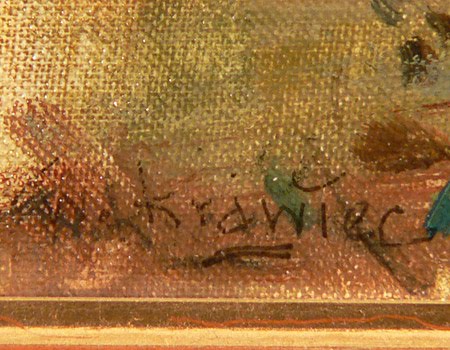
One of these hidden yet brilliant Chicago artists MIR has encountered is Walter Krawiec, a Polish American artist who became a staple in the Chicago art scene from the 1930’s through the 1980’s. So influential was this artist that when one searches the Chicago Tribune archives they encounter no fewer than 133 articles mentioning the artist, nearly 20 of which are exclusively on the artist and his work. Krawiec was born in Morzew, Poland in September of 1889 and soon immigrated to the United States along with his parents at the age of 3 (Mass). Living until the ripe age of 92, Walter Krawiec lived in the Northwest side of Chicago for the majority of his life, working as an artist for 75 years. Aside from the oil paintings and drawings that made him a staple of some of the most influential art galleries in Chicago, Krawiec was a cartoonist for the Polish Daily news for 60 years. Walter’s artistic inclination was shared with his wife, Harriet, another Chicago area artist some of whose works MIR houses in our Michigan Avenue office.
For fifty years Walter’s cartoons greeted Polish readers on the front page of the paper and his personality was such that he received the newspaper’s Veritas et Caritas award as well as being named the paper’s Man of the Year (Mass). Further insight into his personality can be gleaned from an article written in 1968 entitled “Artist-Patient Cheers Up Staff” (A.P.). During his stay at Resurrection Hospital for an undisclosed reason Krawiec is reported to have drawn caricatures of the nurses and doctors who were taking care of him, much to the amusement of the hospital’s staff pictured below in a stock photograph. The article elaborates that his work hung in the galleries of LBJ’s ranch, the home of Mayor Richard Daley and the home of former Governor William Stratton. Interestingly, the ground on which the hospital stood was once a ranch where the artist had painted his early farm scenes.
Krawiec’s art is dominated by a fascination with horses and the circus, two pleasures the artist encountered as a child and two that came to dominate his artistic subject matter. These paintings are remarkable for their mastery of form as well as for their diversity of setting and color, paintings that were able to bring an older age to contemporary viewers during the time. Bringing the country to the city, the artist also painted factory and harbor subjects and was often found painting the stockyards during a time when Chicago was “hog butcher to the world.” Harriet’s art is dominated by still lifes of flowers that often accompanied and complimented Walter’s work while on display in the most popular Chicago galleries.
The legacy of Walter and Harriet left a lasting impact on the communities in which they lived. Walter received an award from a Polish society for his philanthropic work and both were honored at the Poland World’s Fair of 1929 (Weigle).
Their works have been exhibited all over the United States, in the Art Institute and as far away as Poland. News of their latest exhibitions, accomplishments and artistic endeavors filled the pages of the Chicago Tribune for almost half of a century and their work is coveted by well-versed collectors with an eye for quality.
MIR is happy to have dealt in works of this quality and wants to remind collectors of art that their pieces may have a history they are unaware of. Many artists are valuable monetarily and culturally but few of their names are circulated as frequently as names like Picasso, Degas and Warhol. For this reason it is important to seek out the expert opinion of a trustworthy art appraiser who is familiar with these lesser known artists and who will take the time to research the item thoroughly. We compel you to explore our website and our services and recommend you call us should you have questions about your own artwork.
Written and Researched by Justin Bergquist
Principal Appraiser: Farhad Radfar, ISA, AM
307 N. Michigan Avenue, Suite 308
Chicago, IL 60601
(312) 814-8510
Works cited:
“Artist-Patient Cheers Up Staff” in Chicago Tribune, 17 Nov. 1968.
“Mass Set for Walter Krawiec, Polish Daily News Cartoonist” in Chicago Tribune, 13 June 1982.
Weigle, Edith. “Krawiec Art Recalls Era of Childhood” in Chicago Tribune, 26 Feb. 1960.
Friday, November 27, 2009
A MIR Tribute: Barbara Crane's 60 Year Retrospective
On Thursday, I attended a thoughtful, inspired gallery talk led by Abigail Foerstner, essayist on Barbara Crane.
I was quite interested in Abigail’s comment that Crane’s Neon Series showcases a “mask-like ritual property.”
Other striking, novel arrangements of form, pattern, and repetition are developed in such works as Whole Roll: Albanian Soccer Players and in the series Urban Anomalies.

Barbara Crane’s use of repetition builds rhythm and music:
Consider Still Lifes (diptych)—the animal, photographed on both sides and doubled in self-confrontation.
A fellow artist, the sculptor Ann Bannard, gifted the opossum skull to Crane as a wedding present—with a note: “you are the only person in the world I could send a dead animal skull” (Foerstner 247). I admire Crane’s novel interpretation and enlivening of the still life trope—her graceful undoing of romantic notions concerning hermetic arrangements of beautiful objects—in the series we see fangs and frozen whiskers, delicately patterned wings, abstract animal matter. Her series Visions of Enarc similarly disrupts our sense of the romantic, as the towering floral life appears rather threatening:
The Barbara Crane exhibit is ongoing through January 10, 2010. Upcoming related events:
Thursday, December 17, 12:15 p.m.
Gallery talk led by Whitney Bradshaw, Curator of Photography for the Bank of America Collection
Thursday, January 7, 12:15 p.m.
Gallery talk with the artist
Make plans to visit the Chicago Cultural Center, free and open to the public, and MIR Appraisal Services, Inc.—mere blocks from the exhibition! Please make an appointment to see some of the works in our gallery, featuring several works by Chicago artists, including the late Ruth Duckworth, Emmanuel Viviano, among others...
Jessica Savitz
307 N. Michigan Avenue, Suite 308
Chicago, IL 60601
Phone: (312) 814-8510
Works Cited:
Foerstner, Abigail and Rohrbach, John. Barabara Crane: Challenging Vision. Chicago Cultural Center. Chicago: University of Chicago Press, 2009.
Varnedoe, Kirk. A Fine Disregard: What Makes Modern Art Modern. New York: Harry N. Adams, Inc., 1990.
Twitter Updates
MIR Art Appraisers's Fan Box
Profile:
- MIR Appraisal Services, Inc.
- Chicago, Illinois, United States
- Welcome to our blog site! MIR Appraisal Services, Inc. is a fine art and personal property appraisal company dedicated to serving clients throughout the United States and abroad since our incorporation in Chicago in 1994. We specialize in the multi-faceted field of appraising fine art, jewelry, antiques, and decorative items. We also provide professional fine art restoration and conservation treatment for various media, including but not limited to, artworks on canvas, board, masonite, and paper. We offer professional and precise appraisal services carried out by our team of accredited appraisers for the purposes of insurance coverage and claims, charitable donations, estate planning and probate, equitable distribution and fair-market value. We started our art commentary blog site as a venue for colleagues and fellow art enthusiasts to share their experiences within the art community.