

Photographer Adam Ekberg in front of his photograph Aberration #8
A friendly reminder from your pals at MIR—this is the last week to attend the Elements of Photography exhibition at the Museum of Contemporary Art! It’s a lovely array of works that hang like varied planets in the MCA’s little universe, each flashing their own light and brilliance—works such as Aberration #8 and Disco Ball in the Woods by Adam Ekberg.
I witnessed Ekberg’s works in the MCA last summer, and jotted his name in my little notebook, intending to discover more about this striking photographer (his video Disco Ball in the Woods is positively enlivening). Last month at the MCA, I felt very lucky to attend a coffee and conversation event with Ekberg. He led us through the shifting terrain of photography, remarking that the genre of photography is like a perennial adolescent—self-conscious, looking at it shoes, asking timorously, “Is it ok what I’m doing?”
Refreshingly absent from the Ekberg’s talk—the sharp, wooly itch of theory found in “fancy pants” lectures (in fact, Ekberg told us that in his own classes, he usually feigns a trip or a guffaw of some stripe right away to try to put everyone at ease and take the air out of the puffy chest of academia).
Ekberg constructed a marvelous wreath of photographic history. In brief, Ekberg related the passage of photography over the genre-altering threshold of the self-referential; the initially non-negotiable photographic elements—a clear divide between subject and object, a strong emphasis on a singular plane of focus, a scientific cataloging of information, and an examination of society and culture—blend, divide, or shatter.
Ekberg took us on a dazzling tour, from Walker Evans

A Walker Evans subway portrait (Evans’ camera tucked covertly into his jacket)
to Edward Weston; Bern and Hilda Becker to Lewis Baltz;

Lewis Baltz, West Wall, Unoccupied Industrial Structure, 20 Airway Drive, Costa Mesa
from Robert Adams to Diane Arbus and William Eggleston.

William Eggleston, Memphis, Tennessee, 1975
Ekberg remarked that in the 1960s photography asked, “What am I in terms of painting?” This is fascinating in light of the anxiety that photography was the “death of painting” and in terms of Eggleston’s painterly influences. Ekberg related that Eggleston was the photographer to first usher color photography into the realm of what was accepted as “high art.” Suddenly everything was a possibility.
From Candida Hofer

Candida Hofer, Théâtre royal de la Monnaie/Koninklijke Muntschouwburg
to Thomas Ruff; from Andreas Gursky,

Andreas Gursky, Chicago Board of Trade II
to Cindy Sherman and Nikki Lee,; from Gregory Crewdson’s theatrical, “epic moments”

Gregory Crewdson, Untitled, from the series Twilight
to Jeff Wall

Jeff Wall, The Storyteller (One of my favorite photographs. I was so moved seeing this photograph in the Jeff Wall exhibit at the AIC a few summers past)
To Alec Soth’s lyricism

Alec Soth, Peter’s Houseboat (I am so taken with this photograph—the houseboat clad in bones and ice, and some of the best colors I have ever witnessed in my life in the clothes on the line, like colorful life inside a winter animal, strung up on a wire.)
Thank you, Adam, for introducing me to Alec Soth!

Alec Soth, Charles (This is truly one of my new favorite portraits—such a tender, most gentle, understated portrait, model airplanes orbiting the little giant universe of a man dressed in forest colors with white speckled paint. He looks like a humble knight, clad in the clothes of a house-painter.)
* * * *
Ekberg talked about how photography shifts as it reconsiders its relationship with the photographic subject, and also in its negotiations with time in general as it aims for something perhaps more expansive than Cartier-Bresson’s “decisive moment.”

Abelardo Morell, Camera Obscura: View of Florence Looking Northwest Inside Bedroom
Abelardo Morell turns rooms themselves into cameras using the camera obscura; the outside environment is projected into spaces—and we must ask, “What is the camera?” If, in the words of Richard Hugo, “a photograph is death at work,” these recent considerations of the nature of photography shield us from being struck through the heart by the bullet of of time-specificity; the photograph, then, announces a living field.

Uta Barth, from In Between Places
Uta Barth certainly calls into question what the subject can be—the subject can be a liminal thing, an in-between thing.

Uta Barth, Untitled, from the series “…and of time”
Uta Barth:
“In 1998 I made a decision to only make photographs in my house because I wanted to find another way to empty the subject out of my images, to separate meaning and subject. Seeking something to photograph made no sense anymore, but I still had to point the camera somewhere, so I point it at what’s familiar and everyday that it’s almost invisible. I don’t want to become the subject I’ve tried so hard to erase.” (Cheryl Kaplan interviews Uta Barth, http://www.db artmag.de/2006/2/e/1/421.php)
* * * *
Similarly meditative are Hiroshi Sugimoto’s works (an inverse of Maybridge, says Ekberg) who takes one long exposure of a “subject”—as one long breath. In his Seascapes series, the sea is a “time-lapse space,” remarks Ekberg. What Michael Fried identifies as the “quiet grandeur” of Sugimoto’s Seascapes commenced in Jamaica in 1980.
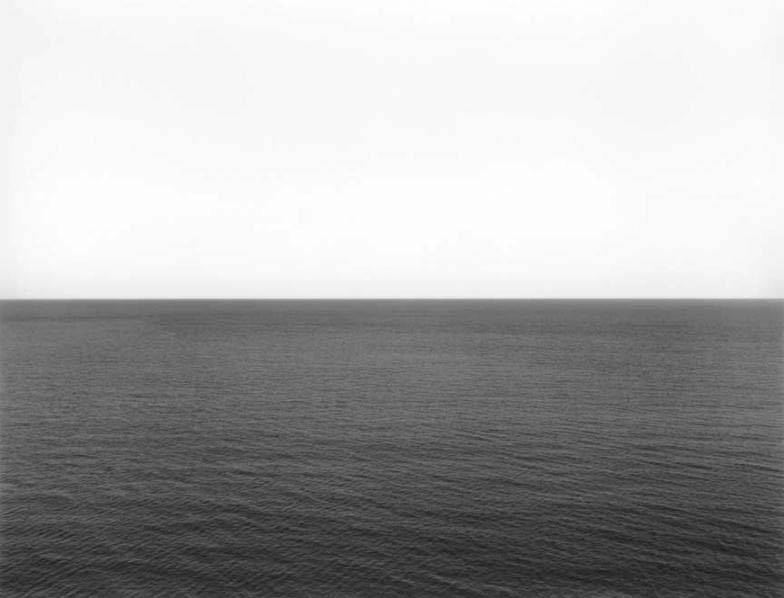
Hiroshi Sugimoto, Caribbean Sea, Jamaica
Each photograph that follows in the series references this initial placement of the horizon line (Sugimoto recorded the placement of the horizon line on his viewfinder) (Fried 294). In the words of Sugimoto,
“’[In the Seascapes] there is no human presence. Because I try to depict the prehuman state of the landscape. It is as if I were the first man to appear on this planet which is the earth. The first man who I am looks around and discovers his first landscape, a marine landscape” (Fried 294).
Michael Fried poetically pairs Sugimoto’s Seascapes with Yukio Mishima’s The Decay of the Angel:
“’The sea, a nameless sea, the Mediterranean, the Japan Sea, the Bay of Suruga here before him; a rich, nameless, absolutely anarchy, caught after a great struggle as something called ‘sea,’ in fact rejecting a name. As the sky clouded over, the sea fell into sulky contemplation, studded with fine nightingale-colored points. It bristled with wave-thorns, like a rose branch. In the thorns themselves was evidence of a smooth becoming. The thorns of the sea were smooth’”(Fried 298).
Fried remarks that the Seascapes are “in no sense views” (Fried 298). They are the meditative pondering of primordial, elemental stuff—they gently undo the formal stage of setting.
These photographs bring to mind these poetic masterpieces from one of my favorite photographers, Roxane Hopper:

Roxane Hopper, from Physical Properties
A little “light event” on the roof of the Smurfit-Stone Building in downtown Chicago:

Roxane Hopper, from Physical Properties (I adore this photograph!)
* * * *
Malanie Schiff engages in performative work which references youth culture, and, in the words of Ekberg, Spit Rainbow records the ephemeral nature of the performative moment.

Melanie Schiff, Spit Rainbow
An excerpt from Nicole Pasulka’s interview with Schiff:
“With Spit Rainbow I had been on a boat with my brother somewhere and there was a teenage boy on the boat with us and he was driving us nuts. All of the sudden he was like, “Look at me, look at me,” and he spit a water rainbow off the boat. I was like, “That’s so beautiful,” but he was obnoxious in kind of a sad way, ‘cause he was a teenager by himself and he just wanted attention. So it was a beautiful gesture from someone who was driving us crazy. It struck me as something I wanted to do. Make a rainbow through this sort of aggressive and stupid teenage gesture.” (http://www.themorningnews.org/archives/galleries/spit_rainbow/)
Ekberg says he would categorize his own work as “performance photography”; the work is not augmented—everything comes together when the photograph is made. He spent hours with this balloon, trying to get the balloon in its floating life to perform in a particular way before this photograph could be made:

Adam Ekberg, A Balloon in a Room
We found out that the rock in A Splash in the Middle of the Ocean is fixed on a piece of asphalt from Ekberg’s apartment building, caught in the precise frame of the photograph as it was thrust into Lake Michigan.

Adam Ekberg, A Splash in the Middle of the Ocean
Ekberg told us he had stopped believing in happy accidents; then he took the photographs for his Aberration series—the ethereal sun-rings—like he painted a halo on light itself!

Adam Ekberg, Aberration #8
For the video Disco Ball in the Woods, Adam carried a disco ball and smoke machine up a mountain with a friend at dusk.

Adam Ekberg, Disco Ball in the Woods
What we choose to focus on and light up becomes the world for us; this seems an integral part of the dazzling spheres in Ekberg’s Aberration #8 and his film Disco Ball in the Woods—here are these little universes revolving with sweet individual power, in private communication with the life force. The spherical “photographic subjects,” placed in the center, make us sense the center of our own psyche. We are viewing our own hermetic life as a precious thing suspended in space.
Mythologist Joseph Campbell often commented upon the ways in which the first moon-landing event forever changed our concept of the cosmos. He felt the poet Giuseppe Ungaretti expressed well the radically jarring perspective we beheld—not of the moon, but of the earth seen from the moon. He often quoted Ungaretti’s poem,
Che fai tu, Terra, in ciel?
Dimmi, che fai, Silenziosa Terra?
What are you doing, Earth, in heaven?
Tell me, what are you doing, Silent Earth?
—Giuseppe Ungaretti
Campbell felt Ungaretti’s verse corresponded to the post-moonwalk mythos which asserted that “cosmological centers now are any—and everywhere” (Campbell 236).
Ekberg’s “light worlds” are cosmic reconsiderations, in the graininess of dusk light, in bright rings of sunlight—and a novel kind of performative work, in which Ekberg allows nature itself to perform as he bears witness, at the ready with his technical savvy.
* * * *
We sit together, the mountain and me
Until only the mountain remains.
—Li Po
* * * *
Thanks to Ekberg and to the MCA for such a dazzling little “coffee and conversation” event—what a perfect way to spend a Saturday morning!
The staff at MIR Appraisal Services, Inc. seeks to fully understand the arts in their particular cultural contexts and to analyze relationships between various artistic mediums and genres; in this way we can broaden our expertise as art appraisers. We are located just steps from the Art Institute of Chicago and the Chicago Cultural Center; please do give us a ring to set up an appointment for a verbal evaluation of your most prized works of art.
Written and Researched by Jessica Savitz
Principal Appraiser: Farhad Radfar, ISA AM
307 N. Michigan Avenue, Suite 308
Chicago, IL 60601
(312) 814-8510
Works Cited:
Campbell, Joseph. Myths To Live By. New York: Penguin Compass, 1972.
Fried, Michael. Why Photography Matters as Art as Never Before. New Haven: Yale University Press, 2008.
http://www.roxanehopper.com/


 Posts
Posts


