My blog has moved!

You should be automatically redirected in 4 seconds. If not, visit
http://mirappraisal.com/mir-blog/
and update your bookmarks.

Friday, April 9, 2010

Chicago Artists Profile Part I: Walter and Harriet Krawiec

The greater Chicago area has fostered the artistic growth of countless architects, authors and artists known the world over. Once the United State’s second largest city, Chicago’s rich artistic history is obvious even before art admirers pass through the doors of the city’s multitude of public museums and opulent homes. MIR Appraisal Services works with estates the world over but is especially fond of the estates of collectors who pay special attention to local artists that have contributed to Chicago’s rich heritage. A great number of artists who hit their creative heights in the Windy City have found international fame, but with such a volume of creative output pouring from the city it is understandable that a few names have remained secrets to all but those with a fine eye for artistic and historic gems.


One of these hidden yet brilliant Chicago artists MIR has encountered is Walter Krawiec, a Polish American artist who became a staple in the Chicago art scene from the 1930’s through the 1980’s. So influential was this artist that when one searches the Chicago Tribune archives they encounter no fewer than 133 articles mentioning the artist, nearly 20 of which are exclusively on the artist and his work. Krawiec was born in Morzew, Poland in September of 1889 and soon immigrated to the United States along with his parents at the age of 3 (Mass). Living until the ripe age of 92, Walter Krawiec lived in the Northwest side of Chicago for the majority of his life, working as an artist for 75 years. Aside from the oil paintings and drawings that made him a staple of some of the most influential art galleries in Chicago, Krawiec was a cartoonist for the Polish Daily news for 60 years. Walter’s artistic inclination was shared with his wife, Harriet, another Chicago area artist some of whose works MIR houses in our Michigan Avenue office.


For fifty years Walter’s cartoons greeted Polish readers on the front page of the paper and his personality was such that he received the newspaper’s Veritas et Caritas award as well as being named the paper’s Man of the Year (Mass). Further insight into his personality can be gleaned from an article written in 1968 entitled “Artist-Patient Cheers Up Staff” (A.P.). During his stay at Resurrection Hospital for an undisclosed reason Krawiec is reported to have drawn caricatures of the nurses and doctors who were taking care of him, much to the amusement of the hospital’s staff pictured below in a stock photograph. The article elaborates that his work hung in the galleries of LBJ’s ranch, the home of Mayor Richard Daley and the home of former Governor William Stratton. Interestingly, the ground on which the hospital stood was once a ranch where the artist had painted his early farm scenes.


Krawiec’s art is dominated by a fascination with horses and the circus, two pleasures the artist encountered as a child and two that came to dominate his artistic subject matter. These paintings are remarkable for their mastery of form as well as for their diversity of setting and color, paintings that were able to bring an older age to contemporary viewers during the time. Bringing the country to the city, the artist also painted factory and harbor subjects and was often found painting the stockyards during a time when Chicago was “hog butcher to the world.” Harriet’s art is dominated by still lifes of flowers that often accompanied and complimented Walter’s work while on display in the most popular Chicago galleries.


The legacy of Walter and Harriet left a lasting impact on the communities in which they lived. Walter received an award from a Polish society for his philanthropic work and both were honored at the Poland World’s Fair of 1929 (Weigle).


Their works have been exhibited all over the United States, in the Art Institute and as far away as Poland. News of their latest exhibitions, accomplishments and artistic endeavors filled the pages of the Chicago Tribune for almost half of a century and their work is coveted by well-versed collectors with an eye for quality.
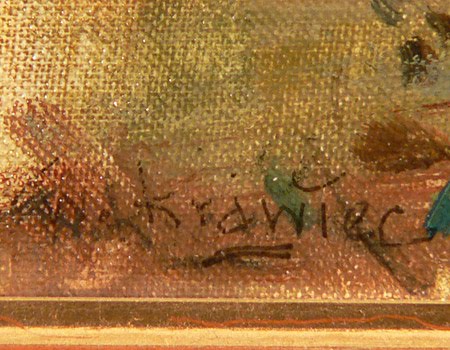


MIR is happy to have dealt in works of this quality and wants to remind collectors of art that their pieces may have a history they are unaware of. Many artists are valuable monetarily and culturally but few of their names are circulated as frequently as names like Picasso, Degas and Warhol. For this reason it is important to seek out the expert opinion of a trustworthy art appraiser who is familiar with these lesser known artists and who will take the time to research the item thoroughly. We compel you to explore our website and our services and recommend you call us should you have questions about your own artwork.


Written and Researched by Justin Bergquist


MIR Appraisal Services, Inc.

Principal Appraiser: Farhad Radfar, ISA, AM

307 N. Michigan Avenue, Suite 308

Chicago, IL 60601

(312) 814-8510


Works cited:

“Artist-Patient Cheers Up Staff” in Chicago Tribune, 17 Nov. 1968.

“Mass Set for Walter Krawiec, Polish Daily News Cartoonist” in Chicago Tribune, 13 June 1982.

Weigle, Edith. “Krawiec Art Recalls Era of Childhood” in Chicago Tribune, 26 Feb. 1960.

Tuesday, April 6, 2010

William Eggleston's "Democratic Camera"

“The world is in color. And there is nothing we can do about that.”

–William Eggleston

William Eggleston, a native of Sumner, Mississippi, has remarked, and I think not cagily, “I don’t see my works as ‘Southern works’” (Knape 15). For me, one of Texas’ native daughters (currently residing in my beloved Chicago), I felt hit in the southern-sun-fevered-head viewing Eggleston, charged with the feeling of the fatigue and poverty and beauty of the Deep South. It’s as if he pulled up a seat for all of these Southern people (all my ancestors included—the Dellas, Granvilles and Garlands from Picayune, MS) at an eerie, greened vanity, and let their faces reflect towards us through the speckled glass.


John Szarkowski observed, “The work… [of the guide]… is on the surface as hermetic as a family album,” reminding me of the ancient photographs I have inherited: droning autumn leaves; “love bugs” in piles of tiny black stars on the dash; green tie-dye formations on the skin of my great uncle’s watermelons, Nana’s camera film, tied into the lap of her dress, suddenly falling into the water as she crossed a creek; my parents as “long hairs” visiting Mississippi in ancient family Polaroids from the 1970s; stockinged feet of southern ladies, grey whiskers of ruined elastic through the weird floral patterns in their house dresses—it all was so dizzyingly familiar to me, and as Eudora Welty brilliantly asserted of Eggleston’s photographs: “Familiarity will be what overwhelms us” (Szarkowski Guide, Ferguson 10).


The ordinary and the strange, twisting, interpenetrating, make the works dizzying—as he remarks in an interview with Ute Eskildsen, Director of the Department of Photography, Museum Folkwang, Essn., “I think, personally, that the world is so visually complicated that the word ‘banal’ scarcely is very intelligent to use” (Knape 12).


Eggleston’s work is lit up, to quote Virginia Woolf (writing here on the essays of Charles Lamb, in a manner that feels most appropriate to Eggleston’s photographs as well) with the “wild flash of imagination, that lightning crack of genius in the middle of them which leaves them flawed and imperfect, but starred with poetry” (Woolf 8). Eggleston stabbed lightning bolts of color through the black-and-whites of acceptable “art photography.” His 1976 exhibition of 75 photographs at the MOMA, entitled Color Photographs, were the basis for the MOMA’s first publication of color photography, William Eggleston’s Guide— part reference book for the dye-transfer technique, part navigation through Eggleston’s landscape (Knape 6).

Eggleston’s use of the dye-transfer technique, rendering color strangely vivid—allows for a process in which each color in a photograph can be singularly tinkered with and rendered.


Eggleston’s universe of color; color itself as a near-setting.


Art critic Sean Callahan reacts: “He emphasizes hues that soak the scene or resonate in a critical way, virtually creating effects of sound, silence, smell, temperature, pressure—sensations that black-and-white photography has yet to make” (Knape 4). Indeed, as the “family of man’s” family albums crack at the binding of black-and-white photographs and open to color photographs, the former seem as tame as braids looped around the head, and the latter wilder and spookier—more familiar and more strange. In using the dye-transfer technique—a method most frequently used in commercial photography of the day—Eggleston applied the most outrageously public mode—advertising—to the most private worlds. It was like advertising the private subject matter, stripping advertising it of its money, and leaving the human figure sitting there all lowly and lovely.


Another important part of his aesthetic concerns his personal experience in the mid ‘60s in an overnight industrial photofinishing lab, confronting and bringing to light the humble, amateur snapshots of Mississippi strangers’ friends and family. This “influence” perhaps informed the treatment of his subject matter— as noted by Thomas Weski in “The Tender-Cruel Camera,” the centrality of the figure in these snapshots find resonance in his works; indeed, Alfred H. Barr, Jr. noted that “the design of most of the pictures seemed to radiate from a central, circular core.” And John Szarkowski characterized Eggleston’s style as “not inappropriate for photographs that might be introduced as evidence in court”— the mug shot or incidental photographic evidence surrounding a crime-scene (Szarkowski Guide). In the essay “Eggleston’s World,” curator Walter Hopps recalls that Eggleston thought of his photographs as “’parts of a novel I’m doing’” (Knape 1).


To answer the tools and amateur art of the era with poetic and technical savvy seems to be a most gripping way to communicate with one’s society— hence the poignancy of Eggleston standing in front of the overnight processing equipment, watching the faces of the everyman rise into being. He artfully rendered some of the motifs suggested in these snapshot-type photos, and more sharply addressed what might have subtly flickered across the faces in these amateur photographs and in the American advertising of the Vietnam War era—a disquieting, portentous feeling. Mark Holborn discovers, “Behind the images there is the sense of danger” (Knape 5)

The heartbreakingly pretty youth, the homely, the peculiar, the irreverent—all are in attendance in Eggleston’s Southern wedding:


Tools are democratic; the camera itself is an objective eye, and in this sense is capable of recording acts of creation or decay, “violence and grace” (Flannery O’Connor).


Curator John Szarkowski on Eggleston’s photographs: “Their intelligence, wit, knowledge and style reach no father back than that person’s—which leads us away from the measurable relationships of art-historical science toward intuition, superstition, blood-knowledge, terror, and delight” (Szarkowski Guide).


William Eggleston, photograph by Mike Brown


William Eggleston: “I am at war with the obvious.”


* * *


William Eggleston: Democratic Camera is on exhibition at the Art Institute’s Modern Wing through May 23rd—an amazing breadth of work, and Eggleston’s first major exhibition in Chicago in over two decades.


* * *


The staff at MIR Appraisal Services, Inc. seeks to fully understand the arts in their particular cultural contexts and to analyze relationships between various artistic mediums and genres; in this way we can broaden our expertise as art appraisers.


Written and Researched by Jessica Savitz


MIR Appraisal Services, Inc.

Principal Appraiser: Farhad Radfar, ISA AM

307 N. Michigan Avenue, Suite 308

Chicago, IL 60601

(312) 814-8510


Works Cited

Ferguson, Russell. Open City: Street Photographs Since 1950, New York: Hatje Cantz Publishers, 2001.

Knape, Gunilla, Director, Hasselblad Center. William Eggleston. Goteborg: Goteborg Museum of Art, 1998.

Woolf, Virginia. A Room of One’s Own. Oxford: Oxford University Press, 2000.

http://www.egglestontrust.com/guide_intro.html

Friday, April 2, 2010

Celebrating Early Springtime with Andy: A Colorful March of Warhol

PART FIVE:

IMAGES AT A REMOVE, A GRAVE, MYSTERY BUS!


The Factory


Marilyn


IMAGES AT A REMOVE

The texture of the story of the original Warhol silkscreen painting, currently undergoing appraisal in our office, feels surreal and lovely like, I imagine, the shock of red velvet in a booth made for Andy Warhol and his groupies, in the back room at Max’s Kansas City. The reason that coming to understand the provenance of the piece registers as so unreal, mythical(see blog from two weeks past) is simply that it’s hard to believe the iconic images of and surrounding Warhol have an actual source, a beginning—it’s hard to feel the human heat in these sometimes icy, removed images.


The marriage between the infinite replicas of images surrounding Warhol and his Factory, and the replicas Warhol perpetuated himself in his silkscreen paintings and prints, build a mountainous, somewhat forbidding presence at times—the cultural fall-out of the experiences of the famous and the now dead, repeated infinitely. (A great Late Modern Art history professor I had a few years back related the story of a Warhol retrospective in LA, remarking that rather than showcasing a varied oeuvre, it would have been more effective to show one repeated motif—to just fill the museum with various replicas of the his tireless Marilyn series or his Flowers.


A GRAVE

* * *

“…repression, however, is not the most obvious characteristic of the sea;the sea is a collector, quick to return a rapacious look.”

—Marianne Moore, from “A Grave”

Marianne Moore signals the deathlike nature of the sea, the sea as a “collector” of lost items and men—Warhol was this, too—the all-encompassing, non-emotive, powerful collector. Pat Hackett recalls his Time Capsules, simple 10” X 18” X 14” brown cardboard boxes—hundreds of them. The boxes held anything he found interesting “Which to Andy, who was interested in everything, meant literally everything” (Hackett xv).” When a box was filled, it would be taped up, dated, put in storage and immediately replaced with an identical looking box. “Dropped things are bound to sink/” continues Moore in “A Grave,” “if they turn and twist, it is neither with volition nor/ consciousness” (Moore 49).


“THERE IS NOTHING DEEPER THAN THE SUPERFICIAL”

This maxim seems to apply to Warhol’s desire to be seen simply. In his own words: “If you want to know who Andy Warhol is, just look at my face, or at the surface of my work. It’s all there” (Danto 9). Indeed his own rather pat description of the Marilyns which follows both “flattens” the concept of celebrity, at the same time making all materials democratically available for consternation and aesthetic meditation: “I just see Monroe as another person. As for whether it’s symbolical to paint Monroe in such violent colors: it’s beauty, and she’s beautiful and if something’s beautiful, it’s pretty colors, that’s all… this is only the beginning, it’ll get better, and everything will be useful decoration” (Goldsmith 88).


Art critic David Bourdon poetically described the effect of the Marilyn Diptych: “The portraits seemed to fade away to some ethereal place… like the persistence of memory after something is gone, or the anticipation of forgetting something before it is gone” (Goldsmith 9).


Warhol’s use of prolific celebrity images creates a strange paradox—maximum exposure of a superficial image. “Warhol’s painting of Marilyn did not impinge on the private person so constantly sought by the curious…The publicity picture itself—and only this picture—is Warhol’s subject” (Shanes 118, Honnef 59). In the words of Warhol: “I did meet Marilyn Monroe, at a party. I thought she was really great. Her movie image was quite different from her personal image though. She was quite quiet” (Wrenn 18).


Eric Shanes reads the Marilyn Diptych from 1962 (now at the Tate Modern in London) as a commentary about exteriority and interiority—the bold colors representing public personality, the black and whites a more hermetic, tragic atmosphere (Shanes 118). Yet maybe this private/public fissure is related to the artist himself; if, in Andy’s words, “Every painting is the same painting. The subject (be it Taylor, Kennedy or Monroe) is not significant,” perhaps it is Andy’s personal concerns with public affectations and private desires, the motifs perhaps of his psyche, which tend to dominate the image (Wrenn 21).


MYSTERY BUS!

A few Sundays past in Chicago:

I’m on State Street, returning from the Patti Smith reading and singing (awesome and strong, and the inclusion of songs such a lovely surprise!), thinking about life in New York in the late ‘60s for these myriad artists, musicians, poets, photographers. I catch the 147 CTA bus just in the nick of time. Totally empty bus, on the beginning of a new run. I sit down and stare at the window, and mark my words, dear readers, this is entirely true—someone had “written” on the window with their finger: “ANDY”—smudged vertically down the glass—there was the name, right in front of my baffled eyes. I spend the next half hour trying to get the photograph, the street lights all blushy or blueish, shining just so behind “ANDY”:


OUR IN-OFFICE MARILYN


Happy Spring!


Written and Researched by Jessica Savitz

MIR Appraisal Services, Inc.

Principal Appraiser: Farhad Radfar, ISA AM

307 N. Michigan Avenue, Suite 308

Chicago, IL 60601

(312) 814-8510


Works Cited:

Danto, Arthur C. Andy Warhol. Yale University Press: New Haven, 2009.

Goldsmith, Kenneth, Ed. I’ll Be Your Mirror:_The Selected Andy Warhol Interviews, Thirty-Seven Conversations with the Pop Master_. Carroll & Graf Publishers: New York, 2004.

Hackett, Pat. The Andy Warhol Diaries. Warner Books: New York, 1989.
Honnef, Klaus. Andy Warhol:_Commerce into Art_. Taschen: Germany, 1993.
Moore, Marianne. The Collected Poems of Marianne Moore. Penguin Booke: New York, 1977.

Shanes, Eeric. Warhol: The Life and Masterworks. Arkstone Press Ltd: New York, 2004.

Wrenn, Mike. Andy Warhol: In His Own Words. Omnibus Press: London, 1991.

Twitter Updates

    follow me on Twitter

    MIR Art Appraisers's Fan Box

    MIR Art Appraisers on Facebook

    Profile:

    My photo
    Chicago, Illinois, United States
    Welcome to our blog site! MIR Appraisal Services, Inc. is a fine art and personal property appraisal company dedicated to serving clients throughout the United States and abroad since our incorporation in Chicago in 1994. We specialize in the multi-faceted field of appraising fine art, jewelry, antiques, and decorative items. We also provide professional fine art restoration and conservation treatment for various media, including but not limited to, artworks on canvas, board, masonite, and paper. We offer professional and precise appraisal services carried out by our team of accredited appraisers for the purposes of insurance coverage and claims, charitable donations, estate planning and probate, equitable distribution and fair-market value. We started our art commentary blog site as a venue for colleagues and fellow art enthusiasts to share their experiences within the art community.